DEVSFLOW / Field Systems
We build and maintain mobile applications for security workforce management, with emphasis on offline operation, field reliability, location workflows, and production support.
Guard-facing applications support long shifts across varied device fleets, indoor and outdoor sites, and intermittent connectivity.
Failures can interrupt required field workflows or weaken the operational record:
Our work covers the following areas:
Production mobile engineering inside an established security workforce platform.
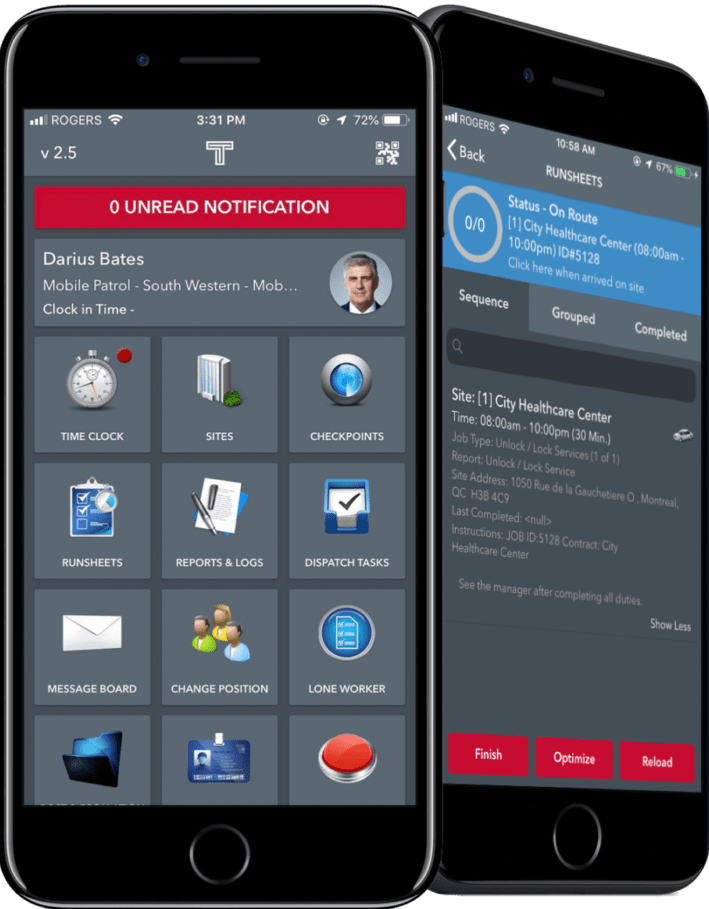
Trackforce provides workforce management software for physical security operations. Its Tracktik mobile product supports field workflows including shifts, patrol activity, incident reporting, and communication with dispatch.
DEVSFLOW engineers joined the existing mobile delivery workflow to accelerate the development of new initiatives and stabilize the legacy application.
The engagement took place in Trackforce's repository and sprint process, covering root-cause analysis, implementation, review, and release follow-through. The stability work cut ANRs by more than 90%.
Technical areas that commonly affect reliability in field operations.
Long shifts turn location, network, screen, and background work into a measurable power budget. We profile the representative workflow on the devices the operation intends to deploy.
Parking garages, basements, and rural sites can have intermittent service. Eligible actions are persisted locally, retried idempotently, and shown with explicit saved and server-accepted states.
Device fleets often include low-memory phones and older Android versions. The test matrix should reflect the actual fleet, its OS builds, storage pressure, and device-management policy.
Checkpoint evidence depends on permissions, fix age and accuracy, indoor conditions, geofence radius, and OS scheduling. We instrument and test those states rather than treating one coordinate as proof.
Push transport is not an end-to-end delivery guarantee. Time-sensitive workflows need application acknowledgements, retry policy, expiry behavior, and telemetry for each state.
Where the operating or contractual requirements call for it, records can preserve actor, device, capture time, receipt time, revisions, and integrity evidence for audit and client reporting.
Mobile engineering capabilities relevant to security workforce systems.
Kotlin development with full access to platform APIs for GPS, background services, push notifications, and device sensors. iOS engineers are available for Swift codebases.
Durable local writes, idempotent upload, visible synchronization state, and conflict policies based on the authority and semantics of each record type.
Platform location and geofence APIs, fix-quality checks, patrol telemetry, and sampling strategies tested against the required accuracy and battery budget.
Native crash analysis, ANR diagnosis, memory leak detection, startup measurement, and regression tests around repaired paths.
Foreground services for user-visible active work, WorkManager for deferrable persistent work, and recovery paths that respect Android's background limits.
Push integration with application-level acknowledgement, expiry and retry policy, notification channels, and measured fallback behavior where appropriate.
Yes. We begin with access, build verification, architecture review, and production telemetry. The initial assessment determines whether targeted remediation is appropriate or broader changes are required.
Start timing depends on current commitments and the access required. A useful first step needs repository access, a reproducible build, production telemetry, and an engineering contact who can explain operational priorities.
Both can be in scope. Existing products usually begin with build verification, telemetry review, and a prioritized risk assessment before remediation or feature work is planned.
We can work in native and cross-platform codebases. The stack decision should be based on the required background, location, camera, NFC, offline, and device-management behavior, plus the team's ability to own native integrations.
We rank issues by operational harm, affected users, data risk, reproducibility, and available evidence.
Release support can include store submissions, review responses, platform privacy declarations, and background-location documentation. Legal and regulatory conclusions remain with the client's qualified advisers.
Technical notes on security workforce and offline field applications.
Send the current architecture, production symptoms, and available telemetry. We can define the initial diagnostic scope and required access.